


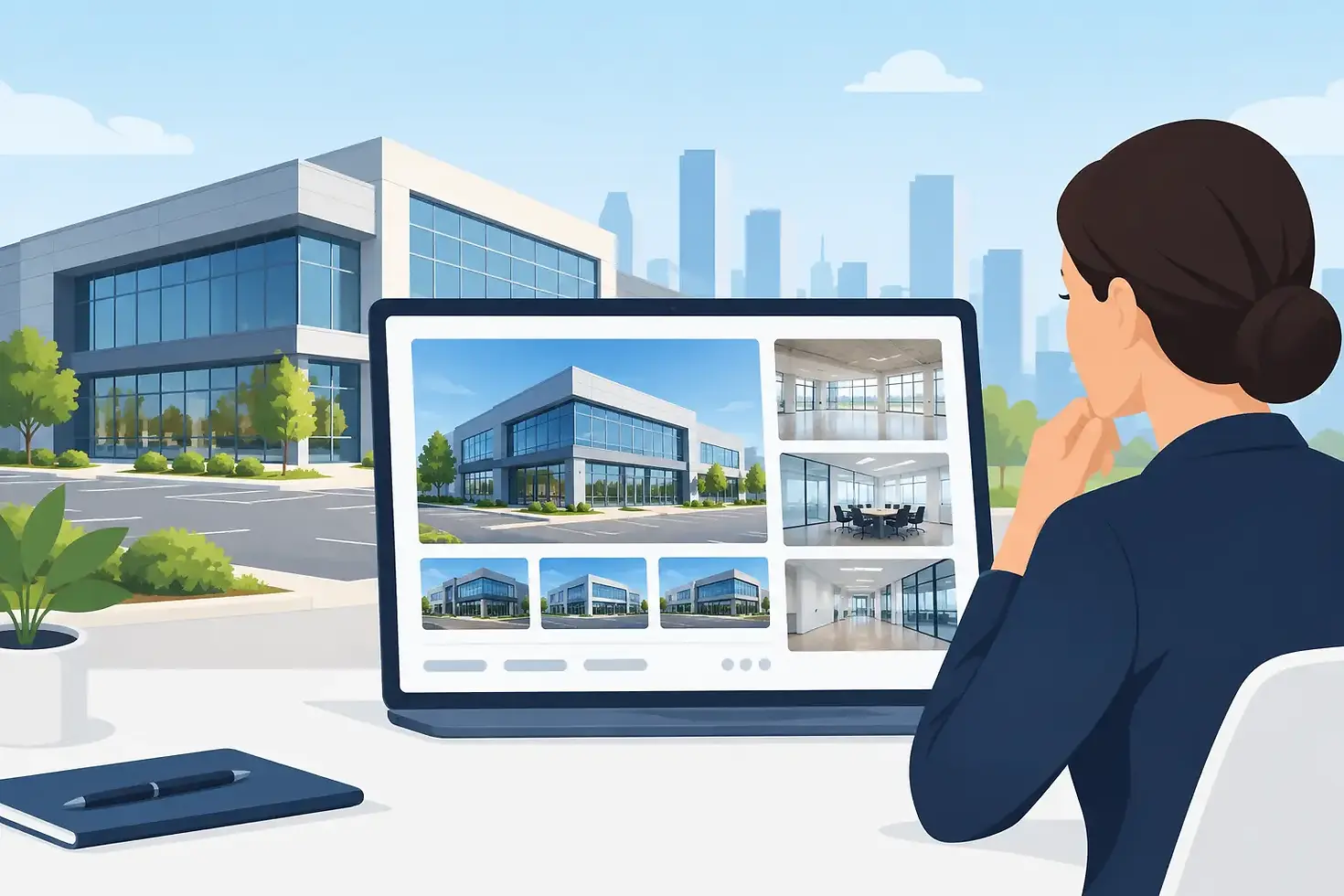
Commercial Listing Visuals Guide for Better Leasing

A commercial property can have the right location, square footage, and zoning, then still lose attention because the listing makes it hard to understand the space. This commercial listing visuals guide focuses on the assets that help prospects quickly assess layout, condition, access, scale, and potential use before they schedule a tour.
Commercial buyers, tenants, investors, and site selectors do not browse listings the same way as residential buyers. They are looking for practical answers: Can this space support our operation? How does traffic move through the property? Where are the loading areas, entrances, parking, and nearby amenities? Strong visuals do more than make a property look polished. They reduce unanswered questions and help qualified prospects take the next step.
Start With the Decision the Listing Must Support
The right media package depends on the property type and the campaign goal. A small office suite being marketed for lease needs a different visual approach than an industrial warehouse, retail center, medical office, multifamily asset, or land parcel. The question is not whether every service belongs on every listing. The question is which assets make a prospect more confident about requesting details or booking a showing.
For an office listing, interior photography, a clear floor plan, and a concise walkthrough video can establish condition, natural light, suite configuration, and tenant-ready features. For industrial property, exterior coverage, drone views, loading docks, clear heights, yard space, and truck access deserve more attention. Retail listings often benefit from street-facing imagery, signage visibility, storefront context, parking, and nearby traffic generators.
Before scheduling a shoot, identify the listing's primary audience and the property features that support their decision. This keeps the production focused on useful proof instead of a collection of attractive but disconnected images.
Commercial Listing Visuals Guide: Build the Core Package
For most commercial listings, professional photography is the foundation. It creates the primary MLS and marketing images, supports brochures and email campaigns, and gives prospects a quick visual scan of the property. The goal is clean, accurate coverage that represents the space well without creating misleading expectations.
Photography should explain the property
A good commercial photo set needs more than wide interior shots. It should show the building exterior, the approach from the street, major entrances, common areas, key rooms or suites, and the functional features that matter to the intended user. In an industrial setting, that may include dock-high doors, grade-level access, electrical infrastructure, warehouse depth, and office buildout. In a retail space, it may mean frontage, pedestrian visibility, signage opportunities, and the relationship between the suite and the parking field.
Accuracy matters. Overly tight crops can hide the context of a room, while excessive wide-angle distortion can make spaces appear larger than they are. Professional editing should improve brightness, color balance, and visual consistency while keeping the representation credible. Prospects who arrive expecting one thing and find another are less likely to move forward.
Floor plans turn images into usable information
Photos show the feel of a space. Floor plans explain how it works. They are especially useful when a tenant or buyer needs to evaluate circulation, room count, suite layout, or possible departmental use before visiting.
A floor plan does not replace verified architectural drawings, and it should not be used as a source for legal measurements. But it gives prospects a faster way to connect images to the overall layout. When included with photography, it can reduce the back-and-forth that often happens when someone cannot tell how individual rooms relate to one another.
For multi-suite properties, make sure the marketing plan distinguishes the available area from common areas and occupied spaces. A clear plan is valuable only when it reflects the listing strategy accurately.
Video creates orientation and momentum
Commercial video works best when it has a job to do. A cinematic walkthrough can show the transition from street to entry, lobby to suite, or warehouse floor to loading area in a way still images cannot. It helps viewers understand flow, scale, and the experience of moving through the property.
Keep the runtime purposeful. A longer video may make sense for a major asset, campus, or redevelopment opportunity. For a standard lease listing, a concise walkthrough is often more effective because it respects the viewer's time and is easier to use in email, social media, and property websites.
Request both horizontal and vertical versions when the campaign will include multiple channels. Horizontal video serves listing pages and presentations well. Vertical clips are better suited for mobile-first social posts and stories. Planning both formats during production avoids trying to force one crop into every placement later.
Use Drone Media When Context Sells the Property
Drone photo and video are valuable when the surrounding environment influences the decision. They can show access roads, freeway proximity, building footprint, lot configuration, nearby retail, views, adjacency, and the relationship between multiple structures on a site.
Aerials are often particularly useful for industrial, retail, land, multifamily, and larger office properties. They can answer questions that ground-level photography cannot, such as how trucks enter the site or how visible a building is from a major corridor.
That said, drone coverage is not automatic. Some locations have airspace restrictions, weather limitations, nearby airports, or site conditions that affect what can be captured. FAA-compliant drone work requires planning, and the property should be evaluated for feasibility rather than promised as a generic add-on. When aerial context is meaningful, though, it can become one of the strongest assets in the campaign.
Add a 3D Tour When Remote Review Is Part of the Process
Interactive 3D tours give prospects the freedom to explore at their own pace. They are a strong fit for office suites, medical spaces, retail interiors, multifamily common areas, and properties with a layout that needs more explanation than a photo gallery can provide.
The trade-off is straightforward: a 3D tour is most useful when the interior is ready to be seen. If the space is under heavy construction, cluttered with move-out materials, or visually confusing because of active operations, photography and a targeted walkthrough may deliver more value until the space is prepared.
For vacant commercial space, a 3D tour can help out-of-area decision-makers narrow their options before traveling. It can also make a listing more useful after business hours, when prospects are researching without an agent on the phone.
Prepare the Property Like a Buyer or Tenant Will See It
Media quality is affected by property readiness. A professional crew can manage light, framing, and editing, but basic preparation protects the value of the final assets. The property does not need to look staged like a residence. It needs to look accessible, maintained, and ready for review.
Before the appointment, confirm access to every area that should be marketed. Remove trash bins, temporary signs, loose cables, personal items, and unnecessary maintenance equipment from primary views. Turn on interior and exterior lights where possible, open shades when the view or daylight adds value, and alert occupants or tenants in advance.
For larger sites, a simple shot plan prevents missed details. Confirm whether the listing needs exterior elevations, monument signage, parking, loading zones, rooftop equipment, amenity areas, specific suite numbers, or nearby points of access. The agent, owner, or property manager usually knows which features answer the most common prospect questions. Sharing that information before the shoot improves coverage and avoids reshoots.
Plan for Fast Delivery and Consistent Use
A listing loses momentum when media arrives in pieces over several days. A practical production workflow should support the marketing timeline: schedule the shoot, capture the required assets in one coordinated visit when possible, and receive organized files that are ready for the MLS, property website, email campaign, and social channels.
Consistency matters even more for teams managing multiple listings. Similar image quality, clear file delivery, and dependable turnaround make it easier for agents and marketing coordinators to launch campaigns without rebuilding their process every time. Benson Productions is built around that operational need, with listing-ready media designed to move from booking to marketing without unnecessary friction.
The strongest commercial listing is not the one with the most media. It is the one where each visual answers a real question, presents the property honestly, and gives the right prospect a reason to request the next conversation.


Comments