


How to Use Drone Shots for Property Marketing

Aerial media can make a listing look bigger, better located, and more memorable in seconds. That is exactly why agents keep asking how to use drone shots for property marketing without wasting budget or adding production delays. The answer is not to film everything from the air. It is to use drone photo and video where they clarify value, support the story of the property, and help buyers or tenants understand what they are looking at faster.
Why drone shots work in real estate marketing
Most listing media shows the property itself. Drone shots add context. They show how the home sits on the lot, what surrounds it, how close it is to amenities, and how the layout reads from above. For commercial properties, aerials can show access roads, parking, neighboring businesses, and overall site flow in a way ground photography cannot.
That context matters because buyers do not just purchase square footage. They evaluate setting, privacy, traffic patterns, nearby features, and curb appeal. A strong aerial image answers questions before a showing is even scheduled. It can also reduce confusion on larger properties where standard exterior photos fail to show boundaries, detached structures, or lot depth.
Drone media also performs well because it creates visual variety. When a listing gallery is made up of only eye-level photos, the presentation can feel flat. A few well-placed aerial shots break that pattern and add scale. Used correctly, they help the listing feel more complete, not more complicated.
How to use drone shots for property marketing strategically
The best drone content starts with a simple question: what should the aerials prove? If the answer is just that the property has a roof, drone coverage is probably not doing much. If the answer is that the estate sits on usable acreage, backs to open space, has ocean proximity, or offers a strong retail location with clear access, then aerials are doing real marketing work.
For residential listings, drone shots tend to be most effective when the lot, setting, or neighborhood adds clear value. Corner lots, view homes, properties with pools or guest houses, and homes near trails, beaches, or golf courses all benefit from overhead perspective. On smaller suburban homes with close neighbors and limited lot distinction, one or two aerials may be enough. More footage does not always mean more impact.
For commercial listings, aerial media often carries more weight. Industrial, retail, office, and multifamily properties benefit from site visibility. Buyers, tenants, and investors want to understand circulation, frontage, parking ratios, nearby anchors, and access points quickly. Aerials can communicate those fundamentals before anyone opens a flyer or requests a tour.
What drone shots should actually capture
A good drone shoot is not just a collection of high-altitude images. The goal is to show the property in layers.
The first layer is the structure itself. Straight-on elevated shots can improve the view of the roofline, front elevation, and lot shape. The second layer is the site. This includes patios, yards, pools, driveways, outbuildings, and parking areas. The third layer is location context. That might mean a nearby coastline, mountain backdrop, shopping corridor, business park, or neighborhood layout.
This progression matters because buyers need orientation. If the drone jumps immediately to a wide regional shot, the property can get lost. If every image is too close, the aerial advantage disappears. The strongest galleries usually move from tight to medium to wide, helping viewers connect the building to its surroundings.
Video follows the same principle. A short, stable orbit or gradual reveal can add polish, but the movement needs to support the story. Fast, dramatic flight paths may look impressive in isolation, yet they often distract from what the property actually offers. In listing media, clarity beats spectacle.
Timing makes a bigger difference than most agents expect
Lighting can make or break aerial media. Midday sun often works against drone photography because it creates hard shadows, blown highlights, and less flattering roof and landscaping detail. Early morning and late afternoon usually produce better color, better depth, and more appealing exteriors.
That said, the right timing depends on the property. A home with a west-facing backyard may look best later in the day. A commercial building surrounded by taller structures may need a narrower window to avoid deep shadow. Coastal properties in Southern California can also be affected by haze or marine layer, so timing has to account for local conditions, not just the clock.
Season and occupancy matter too. Aerials should be scheduled when the property is clean, landscaping is ready, cars are cleared, and any outdoor amenities are staged. An empty pool, construction debris, or full parking lot can reduce the usefulness of an otherwise strong drone set.
Compliance is part of professional marketing
Drone media only helps when it is done legally and safely. That means proper FAA compliance, attention to restricted airspace, and a realistic understanding of what can and cannot be captured at a given location. Near airports, dense urban zones, and certain commercial corridors, approvals or flight limitations may affect the plan.
For agents and property marketers, this is not just a technical detail. It affects scheduling, reliability, and risk. The value of a production partner is not simply having a drone. It is knowing how to assess the property, confirm whether flight is feasible, and deliver usable footage without last-minute surprises.
Privacy is another consideration. Aerial media should market the subject property, not create unnecessary issues by lingering over adjacent lots or neighboring activity. Clean framing and disciplined shot selection keep the focus where it belongs.
How drone shots fit into the full listing package
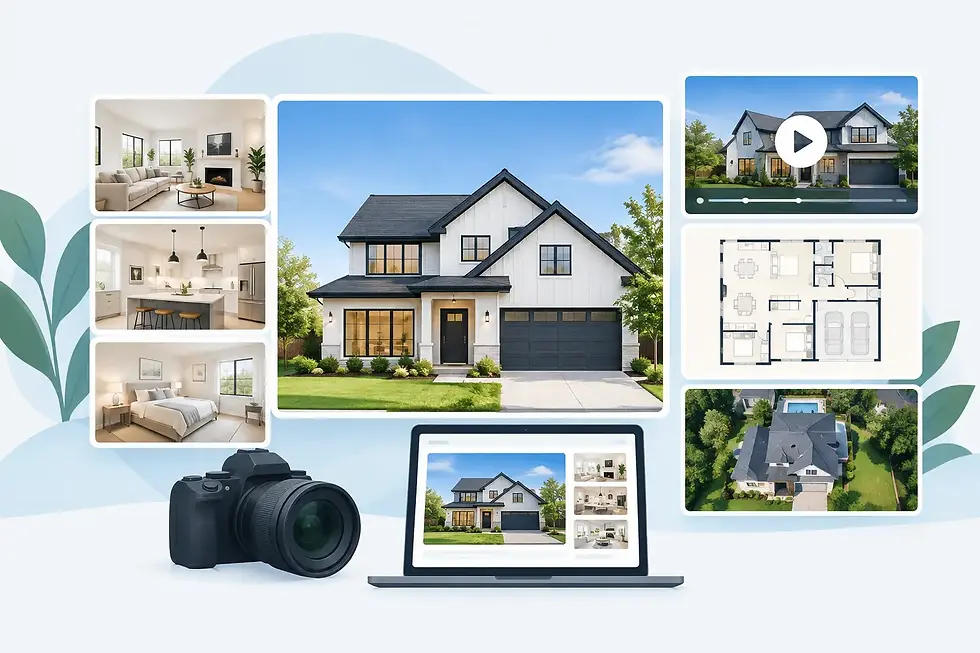
Aerial content works best as part of a coordinated media set. On its own, it adds interest. Combined with professional photography, video walkthroughs, floor plans, and 3D tours, it helps create a more complete presentation that answers different buyer questions at different stages.
Photos handle detail. Video builds flow and mood. Floor plans clarify layout. Aerials provide context. When all of those assets are aligned, the listing feels more credible and easier to evaluate online. That can improve first impressions and help prospects qualify themselves before booking a tour.
This is especially useful for out-of-area buyers, relocation clients, investors, and commercial prospects who may make early decisions based on digital assets alone. They are not looking for visual noise. They are looking for enough information to decide whether the property deserves attention.
Common mistakes when using drone shots for property marketing
The most common mistake is overusing them. Not every listing needs ten aerial photos and a one-minute drone reel. If the value is obvious in two or three frames, stop there. Aerial media should support the listing, not take it over.
Another mistake is using drone shots that are too high or too far away. Once the property becomes a tiny object in a broad landscape, the image may feel cinematic but not useful. Buyers still need to recognize the subject immediately.
Poor editing is another issue. Oversaturated skies, aggressive motion effects, and inconsistent color between ground and aerial media can make a listing feel less professional. Real estate visuals should look polished and accurate. Overprocessing tends to erode trust.
There is also a tendency to treat drone media as a luxury add-on rather than a business tool. In reality, it is most effective when chosen selectively and planned around the property type, target buyer, and marketing channel. A well-timed aerial set can do more than a larger volume of generic content.
A practical standard for deciding when to book aerial coverage
If the property has land, views, access advantages, outdoor amenities, or a location story that matters, drone coverage is usually worth considering. If the listing is compact, visually boxed in, or offers little site distinction, the decision becomes more selective. In those cases, one strong hero aerial may be enough.
The same logic applies to video. Use drone motion when it adds orientation or highlights setting. Skip it when interior flow and still photography already do the job. Efficient marketing is not about adding every available format. It is about choosing the assets that help the listing go live fast and present well from day one.
That is where a streamlined production workflow matters. When drone photo and video are planned alongside the rest of the media package, agents get a cleaner shoot day, consistent delivery, and fewer gaps between capture and launch. For teams managing recurring listings, that consistency often matters as much as the footage itself.
A good drone shot should answer a question the ground cannot. If it shows scale, setting, access, or value more clearly, it earns its place in the marketing package. If not, keep the edit tight and let the strongest visuals do the work.


Comments