


7 Best Visual Upgrades for Listings That Sell

A buyer scrolling past a listing has already made a quick judgment before they read the remarks. Are the rooms bright? Can they understand the layout? Does the property feel worth a showing? The best visual upgrades for listings answer those questions immediately, giving buyers, tenants, and investors a clearer reason to keep looking.
For busy real estate professionals, the goal is not to add media for the sake of it. It is to choose assets that make a property easier to evaluate online, easier to share, and faster to launch across the MLS, property website, email, and social channels. The right mix depends on the property, audience, and marketing plan.
Start With Professional Listing Photography
Professional photography is the baseline upgrade for nearly every residential or commercial listing. It sets the visual standard across the MLS and creates the core image library used everywhere else. Clean compositions, balanced exposure, and a deliberate shot sequence help a buyer understand the property without feeling like they are clicking through disconnected rooms.
Good listing photos should do more than document finishes. They should establish curb appeal, show the relationship between key spaces, and make the strongest selling features easy to spot. In a home, that may be a renovated kitchen, natural light, a view, or indoor-outdoor flow. In a commercial property, it may be ceiling height, storefront visibility, parking, common areas, or the condition of a buildout.
Photography also needs to be MLS-ready. Agents should receive images sized and organized for immediate use, with vertical options available when social posts and short-form video promotion are part of the launch. Next-morning delivery matters here. A listing that is ready to publish the day after a shoot has less time sitting in limbo while marketing materials are assembled.
The Best Visual Upgrades for Listings Add Context
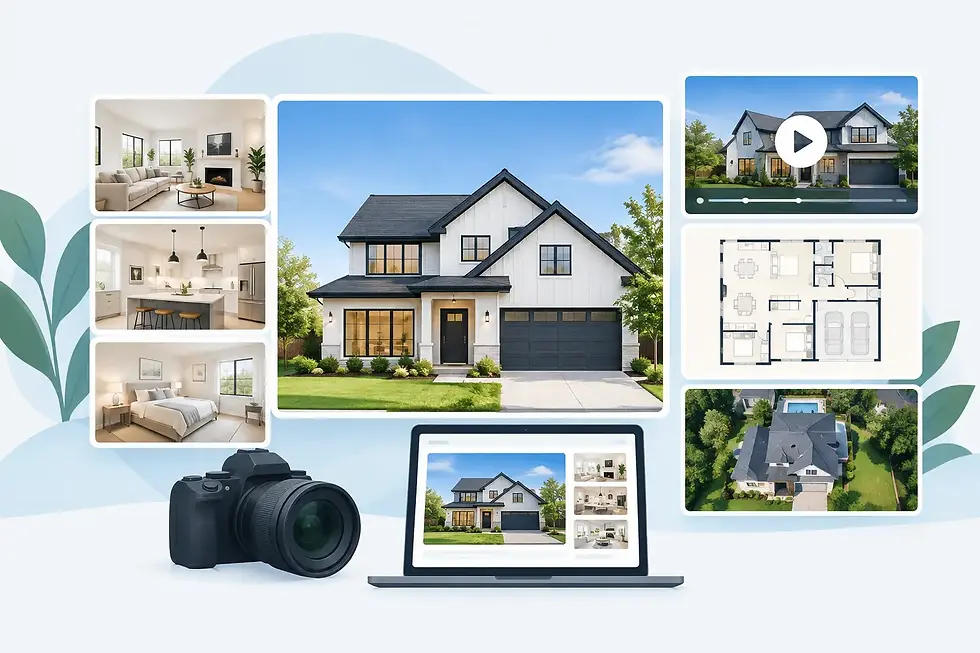
Once the photography is covered, the most valuable upgrades are the ones that answer questions static images cannot. Video, aerial coverage, 3D tours, and floor plans each give a different kind of context. Choosing all of them is not always necessary, but choosing the right combination can make the listing feel complete rather than incomplete.
1. Cinematic Video Walkthroughs
Video creates pacing, movement, and atmosphere. A well-produced walkthrough can show how a buyer enters the home, moves through the main living areas, and connects with outdoor spaces. For a luxury residence, a view property, a new development, or a rental with lifestyle appeal, that sense of flow can be a meaningful advantage.
Video is especially useful when the listing will be promoted beyond the MLS. Horizontal edits work well for property websites and longer presentations, while vertical cuts give agents usable material for Instagram Reels, TikTok, and Stories. The footage should be steady, concise, and built around the property, not elaborate effects that distract from it.
There is a trade-off. A small, straightforward condo may not need a long cinematic film if strong photography and a floor plan provide enough clarity. A short social-ready video can be the better fit. Larger homes, architecturally distinct properties, and commercial spaces with multiple areas usually benefit more from a fuller walkthrough.
2. FAA-Compliant Drone Photo and Video
Aerial media helps buyers understand what surrounds the property. It can show lot size, roofline, backyard layout, proximity to the coast, nearby parks, access roads, or a commercial building's parking and visibility. In Southern California, where views, terrain, outdoor living, and location often influence value, drone coverage can provide context that ground-level photography cannot.
Drone work should be purposeful. The best aerial images identify a real selling point, such as a corner lot, a large parcel, a pool yard, or proximity to a destination. Aerial video can establish the neighborhood before transitioning into a walkthrough.
Not every address is suitable for drone coverage. Airspace restrictions, weather, neighboring properties, and the actual surroundings all affect whether it adds value. Using FAA-certified operators and planning the flight around the listing's strongest location features keeps the result useful and compliant.
3. Interactive 3D Tours
A 3D tour gives remote prospects control. Instead of waiting for an open house or trying to infer a layout from still images, they can move through the space at their own pace. This is particularly helpful for relocation buyers, busy professionals, investors, occupied homes, and commercial prospects coordinating multiple site visits.
The operational benefit is just as practical. Better-informed prospects can arrive at showings with a stronger understanding of the property, which can reduce unnecessary traffic and improve the quality of inquiries. For property managers and short-term rental operators, an interactive tour can also set more accurate expectations before a guest or tenant visits.
A 3D tour is most effective when the space is prepared carefully. Clutter, closed-off rooms, inconsistent lighting, and unfinished repairs are more noticeable when someone can explore independently. If a property is vacant or has a layout that is difficult to explain through photos, a tour is often one of the strongest upgrades available.
4. Clear, Accurate Floor Plans
Floor plans are among the most practical visual assets in a listing package. Photos show appearance; floor plans show relationships. Buyers can see bedroom placement, room dimensions, circulation, and how the home may function for their daily needs.
This matters for families comparing bedroom wings, buyers deciding whether a home office will work, and commercial prospects evaluating usable space. A floor plan also helps an agent answer common questions before they turn into follow-up emails. It is a simple addition that supports faster decision-making.
Floor plans should be clean, legible, and clearly labeled. They are not a substitute for verifying square footage through the appropriate sources, but they are an excellent planning tool for buyers and tenants. When included with the media package, they also remove one more task from the listing coordinator's workflow.
5. A Dedicated Property Website
MLS systems are essential, but they are designed for standardized property data. A dedicated property website gives the listing a focused home for its photos, video, 3D tour, floor plan, and key details. It is easier to send in an email, feature in a social post, or share directly with a buyer who wants one place to review everything.
The best property websites are simple. They load quickly, look polished on mobile, and organize the media without forcing visitors through a maze of tabs. For agents, that means a cleaner presentation with less effort. For consumers, it means fewer reasons to leave before they understand the opportunity.
6. Twilight Images for the Right Property
Twilight photography can create a high-impact lead image when a property has strong exterior lighting, a pool, city lights, or a view. It can help an estate or design-forward home stand apart in a grid of daytime exterior photos. The contrast between warm interior light and the evening sky often creates a strong emotional first impression.
It is not a universal requirement. A property with limited exterior features or an ordinary front elevation may gain more from excellent daylight photography than a staged twilight shot. Use twilight coverage when it reveals something the daytime set cannot, not just because it feels like a premium add-on.
7. Consistent Formats and Fast Delivery
The final upgrade is less visible, but it has a direct effect on listing performance: a production process that keeps everything moving. Media is only valuable when it reaches the agent in usable formats, on schedule, and without a string of follow-up requests.
A dependable real estate media partner should provide clear booking, consistent quality, practical add-ons, and delivery that matches the pace of the listing calendar. Benson Productions is built around that workflow, helping Southern California agents receive listing-ready visual assets without adding friction between the shoot and the launch.
Build the Package Around the Property
A standard single-family listing may need professional photography, a floor plan, and a property website. A view home or luxury listing may call for photography, cinematic video, drone coverage, a 3D tour, and twilight images. For commercial marketing, photography, aerials, floor plans, and a tour can provide the clear spatial and site context tenants or investors need.
The deciding question is simple: what would a serious prospect still need to know after viewing the photos? If the answer is how rooms connect, add a floor plan or 3D tour. If it is why the location matters, consider aerial media. If the property's experience is the selling point, use video to show it.
The strongest listing package is not the one with the most files. It is the one that gives the right buyer enough clarity to take the next step with confidence.


Comments